
Why EdTech Sales Plays by Different Rules Than B2B SaaS

The teacher loved it. The pilot went well. The classroom results were real. And then the deal sat untouched for three months because IT needed to review data security and student privacy compliance.
If that sequence sounds familiar, you're not doing anything wrong. You're selling into a system that was never built to move at typical B2B SaaS speed, and treating it like one is where a lot of otherwise-strong EdTech deals stall.
Here's what makes selling into schools so different.
You're Rarely the First Option in the Room
Most schools already have something in place. Legacy platforms are deeply embedded into curriculum, workflows, and staff habits, which means you're asking someone to unwind something they've already built their year around. That's a much harder ask than “switch tools,” and it's worth acknowledging directly instead of pretending you're walking into a blank slate.
The Buying Committee Has Many Stakeholders
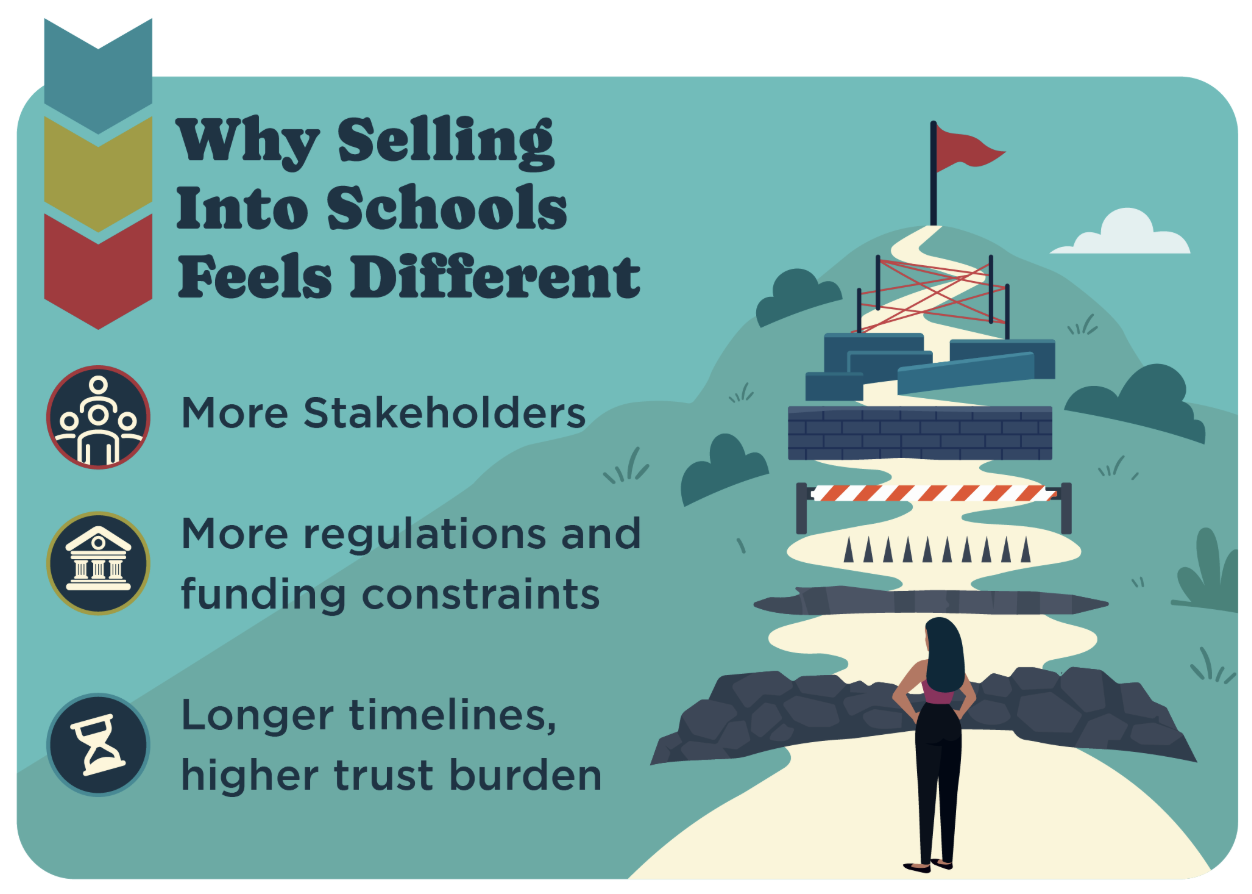
In typical B2B SaaS, you might be selling to one or two decision-makers. In EdTech, superintendents, curriculum leaders, principals, IT, finance, and often teachers all weigh in before a deal moves forward.
This teacher-to-IT gap often becomes a big roadblock. Teachers evaluate a tool on whether it makes their job easier. IT evaluates it on whether it puts student data, compliance, and system integrations at risk. Those are two completely different sets of criteria, and winning the first doesn't guarantee anything with the second.
Long Procurement Cycles Mean Long Approval Processes
RFPs, legal review, and board timelines can stretch for months. Layer on top of that the reality that many district budgets depend on state, federal, Title, or grant dollars with strict rules attached, and you have a procurement process with a timeline that has very little to do with how excited any one person is about your product.
You Need to Show Proof Before Purchase
Pilots, efficacy data, compliance documentation, and implementation planning are often required before a district will even consider expanding a relationship. Districts aren't being difficult here. They're managing risk on behalf of students, and that requires more evidence upfront than most SaaS categories ask for.
Academic Calendar Pressure and Timelines
Decisions are tied to school-year timing, testing windows, staffing changes, and budget season, not your fiscal quarter. A deal that makes total sense in March can be functionally impossible to move forward on in May, simply because of where that falls in the academic calendar.
Winning the Deal Isn't the Finish Line
Even after the contract is signed, training, adoption, rostering, SIS/LMS integration, and ongoing support matter as much as the sale itself. A district that adopts your tool and doesn't see smooth implementation is a district that won't be renewing, and won't be your reference for the next deal either.
What These Challenges Mean for Your EdTech Go-to-Market Strategy
If your marketing and sales motion is built around a typical B2B SaaS cycle, you're optimizing for the wrong finish line. A few shifts worth making:
Bring IT into the conversation earlier, not after the teacher champion has already fallen in love with the product. Have your security and compliance story ready before it's requested.
Build proof before you need it. Compliance documentation, pilot data, and implementation plans shouldn't be assembled reactively once a district asks. Have them ready to go.
Message to each stakeholder differently. The pitch that wins a teacher and the pitch that satisfies IT are not the same pitch, and trying to make one message do both jobs usually satisfies neither.
Plan your campaigns around the academic fiscal calendar, not your internal quarter. Awareness built at the wrong time in the school year can sit dormant for months.
Great EdTech sales require patience, policy awareness, trust, and flawless execution. It's a longer game than typical B2B SaaS, but it's a winnable one when your go-to-market strategy accounts for how districts actually buy.
If your EdTech sales cycle keeps stalling in the same place, the Clever Lucy team can help you build a strategy that speaks to every stakeholder in the room. Book a 15-minute intro call to get started.